

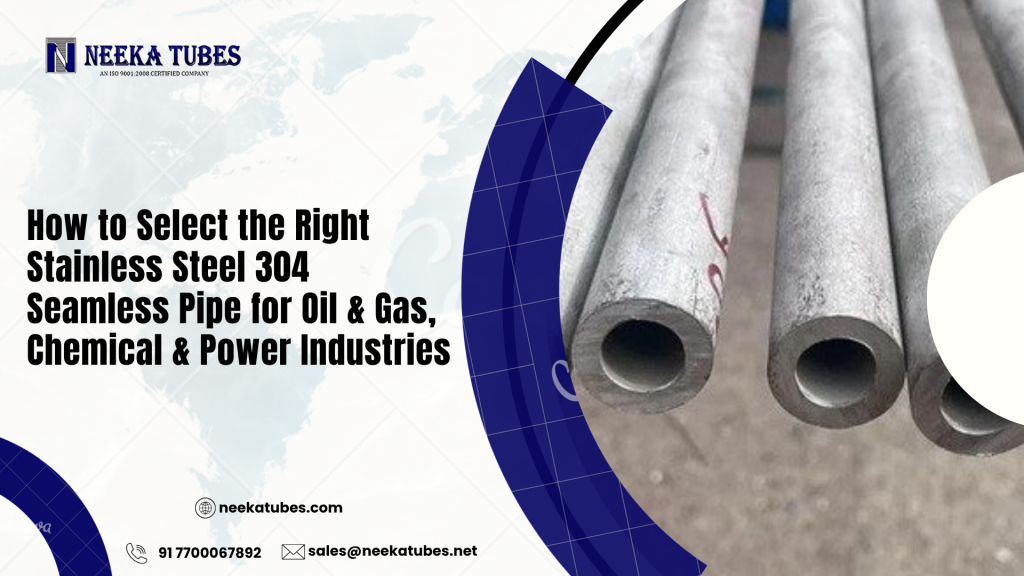
Choosing Stainless Steel 304 seamless piping requires detailed evaluation beyond a basic line item on a purchase order. Buyers check temperature and media against chloride tolerance and work through bore size, schedule and wall thickness before touching the standards it needs to meet. If one of these is wrong, the failure shows up months after commissioning. This guide explains each checkpoint that procurement and project engineers work through.
Why SS 304 Seamless Pipes Are Widely Used Across Industries
304 pairs 18-20% chromium and 8-10.5% nickel with a completely resolved, seamless wall, which is why the grade is identified on various specification sheets. In continuous-pressure service, the absence of a weld seam is significant because it removes a single point on the wall where corrosion and pressure failures concentrate first. Compare it against Stainless Steel Welded Pipes: welded pipe narrows the cost gap on larger diameters, but the fusion line stays a weak point without radiographic inspection. Stainless Steel 304 Seamless Pipes skip that variable, holding their place across process plants, refineries and power stations.
Key Factors to Consider Before Selecting an SS 304 Seamless Pipe
Two variables decide whether 304 is even the right starting point: what the pipe will see in service, and how corrosive that service actually is.
Operating Environment
Operating environment sets the outer limits on where 304 stays reliable. Continuous service above roughly 425°C moves the material into the sensitization band running up to about 815°C, where chromium carbides precipitate at grain boundaries after welding and open the heat-affected zone to attack. Pressure class also needs to be checked against temperature, since a Schedule 40S pipe’s allowable pressure drops as the design temperature climbs.
Corrosion Exposure
Stainless Steel 304 Seamless Supplies withstands nitric acid, most organic acids, and general atmospheric exposure, since the chromium oxide layer stays intact. Chloride ions break that layer down locally, causing pitting and, under stress at temperature, cracking. Past a certain chloride level, the move is Stainless Steel 316 Pipes, where added molybdenum raises pitting resistance.
Selecting the Right Pipe Size and Wall Thickness
Pipe size and wall thickness is decided by flow rate and pressure class together. Bore diameter controls velocity and pressure drop; too small raises erosion risk, too large adds unneeded weight. Wall thickness, expressed as schedule (5S through 80S for stainless), sets allowable working pressure at a given temperature.
Choosing SS 304 Seamless Pipes for Different Industries
Stainless Steel 304 Seamless Pipe Applications shift by sector. Oil and gas, chemical processing and power generation each includes a different property of the same base material.
Oil & Gas Industry
Oil and gas lines require a pipe that holds its pressure rating through temperature swings without weld-seam risk. 304 covers utility lines, instrument air and non-sour process service well. Sour service, defined under NACE MR0175/ISO 15156, is different: 304 is not the first choice, and 316L or duplex grades take over once H2S and chlorides are both present.
Chemical Processing
Chemical processing depends on matching the pipe to the specific reagent. 304 handles nitric acid, most caustics and general process water well.
Power Generation
Power generation uses 304 seamless pipes on steam lines, condensate return and feedwater heaters. High-temperature steam service needs the sensitisation range checked again, since welded joints held in that 425-815°C band for years are where intergranular issues turn up. Stabilised or low-carbon variants often get specified on extended-service steam headers for that reason.
Understanding Industry Standards and Specifications
ASTM A312 (or ASME SA312) covers seamless and welded austenitic stainless pipe, including 304, and sets composition, mechanical property and testing requirements. Schedule and dimensional tolerances follow ASME B36.19M. Power piping falls under ASME B31.1; process piping under ASME B31.3. A mill test certificate should reference the exact standard and revision the order requires.
Common Selection Mistakes to Avoid
Price decides too many pipe orders, and it is the fastest way to end up with the wrong wall thickness or an untraceable heat number. Pipe schedule gets picked by habit, matching what was ordered last time instead of current pressure and temperature. Mill test certificates get filed without checking they match the heat number on the pipe. Dimensional tolerance at the weld end rarely gets verified before the pipe reaches site, and that is usually where fit-up problems start.
Tips for Working with a Reliable Stainless Steel 304 Seamless Pipe Supplier
A supplier’s manufacturing capability decides whether the pipe on the truck matches the pipe on the data sheet. Verify their Manufacturing Facilities for piercing and specification capacity in the sizes needed. Quality Assurance processes and Testing & Inspection records, including hydrostatic and non-destructive testing, should be available before the order is placed. Mill Test Certificates should link to the actual heat number on the pipe. Neeka Tubes distributes Stainless Steel 304 Seamless Supplies oil, gas, chemical, and power facilities. Documentation for these materials includes heat-traceable material test certificates.
Conclusion
Choosing the right Stainless Steel 304 Seamless pipe depends on checking application requirements, operating conditions, dimensions, standards and supplier capability together. A pipe that passes on chemistry can still fail on schedule selection, and a mill certificate that looks complete can still miss the standard reference a project needs. Working through environment, sizing, industry-specific service and supplier verification in that order catches most problems before they surface.