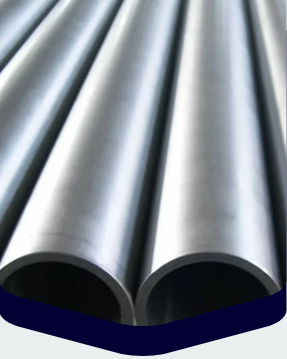
Stainless steel tubes are cylindrical components that are produced using corrosion-resistant steel alloys, which are highly recognized for their high strength and endurance against extreme environments. These tubes play a vital role in the oil & gas, construction, automotive, chemical processing and food handling industries because of their high-temperature, and high-pressure performance.
This blog describes the process of producing stainless steel tubes welded and seamless, from raw material to final inspection, and how they are used.
1. Types of Stainless Steel Tubes
Seamless Stainless Steel Tubes
Seamless stainless steel tubes are resistant to corrosion and have a smooth and uniform surface without welds. Ideal for high-temperature and high-pressure use, as it provides reliability in the oil & gas, chemical and power generation industries.
Welded Stainless Steel Tubes
Welded stainless steel tubes are produced by rolling strips of steel and welding, offering cost-effective options for low to medium pressure applications. They provide excellent corrosion resistance and are commonly used in structural, decorative, and automotive applications.
Key difference between seamless and welded stainless steel tubes:
Strength and Pressure Resistance
- Seamless Tubes are more durable and can tolerate higher pressure and temperature, thus being more suitable for high-stress and critical applications such as power plants, chemical processing, and oil & gas
- Welded tubes consist of a welded seam, which may be a pressure weak point and thus not as ideal for high-pressure applications.
Cost-Effectiveness
- Welded tubes are affordable, and more cost-effective due to easy manufacturing processes and less material wastage.
- Seamless tubes are more costly due to their production process and higher performance.
Dimensional Accuracy
- Welded tubes provide improved dimensional stability and tolerances, which are suitable for uses, such as architectural building and automotive parts.
- Seamless tubes can have minor variation because of the extrusion process.
Surface Finish
- Welded tubes usually have a smoother interior finish something that is useful when it comes to aesthetic or fluid-sensitive processes.
- Seamless tubes can involve further finishing to give a finished look.
Application Suitability
- Seamless tubes are more suited for high-performance, high-pressure, and safety-critical applications.
- Welded tubes are used for general-purpose applications where excessive strength is not needed.
2. Raw Materials
Stainless steel tubing is normally made from grades 304, 316, 321 and 904L, depending on corrosion resistance and use. Seamless tubes are produced from solid billets, whereas welded tubes are produced by utilizing stainless steel coils. Materials are cleaned and prepared on the surface before processing to deliver high-quality output.
3. Manufacturing Process
A. Seamless Tube Production
- Heating and Piercing
A solid piece of stainless steel is heated to about 1200°C and then pierced with a rotary piercer or cross-roll piercer, creating a strong hollow tube.
- Hot Rolling/Extrusion
The pierced billet is then elongated and narrowed in diameter through the use of hot rolling or extrusion procedures to obtain the desired thickness, and length of the tube.
- Cold Drawing
The hot-formed tube is passed through a precision die at room temperature to minimize its diameter enhance dimensional precision, and improve surface smoothness.
- Annealing
The cold-drawn tube is annealed in a heat treatment that softens the metal, relieves internal stresses and reestablishes its ductility for further processing.
- Pickling
The tube is put into an acid bath to clean off surface oxides, scales, and contaminants, leaving it with a clean, corrosion-resistant finish.
- Sizing & Final Inspection
We check tubes through sizing rolls for uniform size, straighten them and conduct extensive tests using visual and non-destructive examination techniques to meet quality requirements.
B. Welded Tube Manufacturing
- Slitting Coils
Tubes are cut from big stainless steel coils into narrower-width strips according to the required tube diameter. This provides optimal material utilization and consistent tube dimensions.
- Forming the tube
The slit strips are slowly curved in a circular shape using a series of forming rolls. This method forms the flat strip into a tube without closing the seam.
- Welding the Seam
The edges of the tube are welded and closed by TIG (Tungsten Inert Gas), or laser welding. This technique forms a strong, solid seam along the length of the tube.
- Weld Bead Removal
If necessary, trim away the raised bead inside or outside the tube after welding to achieve a smooth finish. This is especially important for tubes used in hygienic or high-precision applications.
- Annealing and Pickling
The tubes are annealed to soften them and enhance ductility. Pickling is applied to remove surface oxides and impurities by enhancing corrosion resistance and surface finish.
- Sizing & Quality Check
The tubes are resized and straightened for exact dimensions and then subjected to stringent quality checks to guarantee strength, surface finish, and dimensional accuracy according to industry standards.
4. Surface Finishing Options
Stainless steel tubes may undergo various surface treatments. Pickled finishes remove scale and enhance corrosion resistance. Polished finishes (grit or mirror) provide aesthetic, and cleanliness advantages. Ultra-clean, sanitary applications like pharmaceuticals and food processing using electropolishing.
5. Quality Control & Testing
To ensure product dependability, tubes are subjected to dimension and surface inspection, non-destructive tests like ultrasonic and eddy current testing and hydrostatic pressure testing. Manufacturers follow international standards like ASTM, ASME and EN for conformity and uniformity.
Conclusion
The manufacturing of stainless steel tubes is a careful process from raw material sourcing to surface treatment and testing. Seamless or welded, each tube is designed for strength, durability and performance under harsh conditions. Choosing certified producers ensures quality products that meet international standards and industrial specifications.